Descripción
SKU: TPH12SP9-10Q1PT
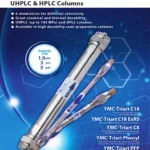
YMC-Triart Phenyl: Features & Benefits
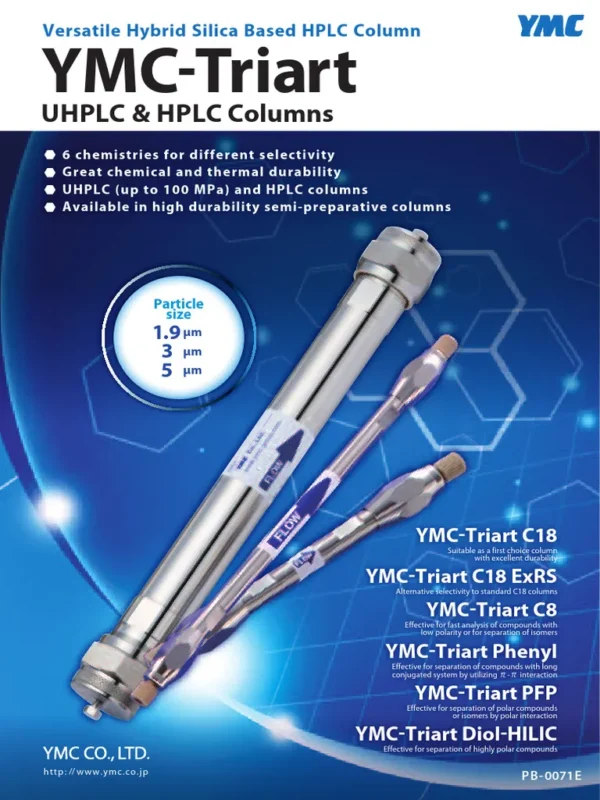
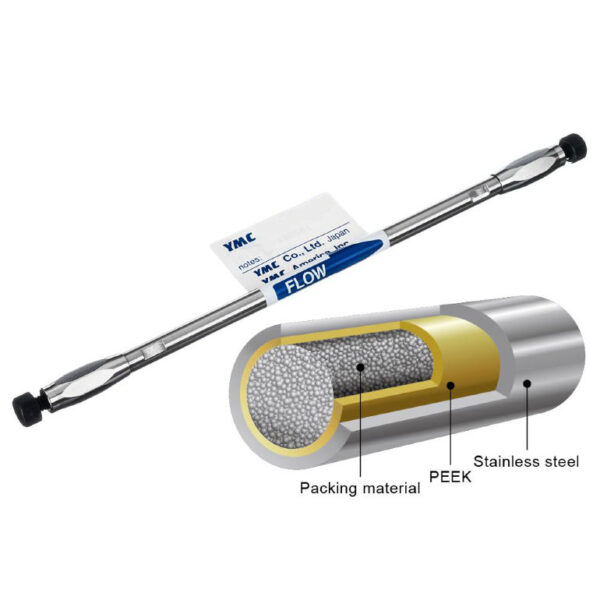
Phenyl phase bonded to organic/inorganic hybrid silica particle
Different selectivity from C18 or C8 with polar interaction and π – π interaction playing a significant role in the separation
Superior chemical durability
Identical selectivity over particle sizes
Ideal for HPLC and UHPLC
Effective for separation of compounds with long conjugated unsaturated systems
YMC-Triart columns are well-suited to a variety of applications in pharmaceutical and chemical laboratories. YMC-Triart’s performance in wide-ranging conditions arguably makes it an ideal universal reversed-phase column choice.
Unique Selectivity
Phenyl columns often provide unique separations compared to aliphatic phases (ex. C18, C8, and C4) as interactions between the analyte of interest and the phenyl stationary phase often result in unique selectivity for aromatic molecules.
YMC-Triart Phenyl can be used at temperatures up to 50⁰C at pH ranging from 1-10. This allows the chromatographer to choose a wide range of pH and temperature conditions as additional tools to produce separations with adequate retention and separation.
Triart Hybrid Advantages
The core material for all of the YMC-Triart products – the particle – is inspired by YMC’s flow chemistry technology. Inherent in YMC’s process is a high level of temperature and particle formation control. As a result, Triart particles are consistent, reproducible, and scalable across many particle sizes. The hybrid Triart particles produce a material that is highly resilient and robust when used at extreme pH and elevated temperature. In addition, these particles are very stable under mechanical stress such as high pressure.